{{ cur.source }}
Project Aria Research Summit · Poster Companion
Toward Personal Egocentric AR Journaling
Evidence Capture · Edge Processing · Retrieval · Memory
Turning continuous first-person video into compact, agent-ready evidence — not just raw footage.
Future AR glasses may continuously capture what a person sees, reads, touches, and hears. But raw egocentric video is long, noisy, private, and difficult for AI agents to use directly. This project frames personal AR journaling as an evidence-lifecycle problem: how to capture meaningful moments, process them under user control, retrieve them efficiently, and serve them to personal agents when they are useful.
Completed Work
Ongoing Pilot
Early Exploration
System Vision
Rutgers University / WINLAB · Systems & Multimedia Lab · Zihao Ding & Dr. Yao Liu
This page synthesizes ongoing Project Aria exploration and prior collaborative research. The components are evaluated independently and point toward a future integrated system.
The Evidence Lifecycle
From first-person sensing to a grounded personal agent
Hover, tap, or focus a stage to read what it does. The five stages connect ongoing Project Aria work with prior systems research on privacy, retrieval, and context serving.
→
⟳ Feedback to the wearer may return through phone UI, voice, or future AR display output. · Conceptual end-to-end flow; components are evaluated independently.
Module 01 · Constructing Egocentric Evidence
Ongoing Project Aria Pilot
Turning reading moments into timestamped, searchable evidence
Our ongoing offline prototype focuses on reading events. It starts from Project Aria video and eye-gaze data, detects likely reading intervals, extracts candidate frames, uses gaze to guide region selection, and applies cropping and OCR to produce timestamped text evidence.
This is an engineering prototype rather than a completed memory system: the current endpoint is evidence extraction, while long-term storage, retrieval integration, and systematic evaluation remain future work.
Route A · Modular CV Pipeline
Aria video + gaze→
reading-event detection→
candidate frames→
representative frame→
gaze-guided crop / SAM→
OCR→
evidence record
Route B · Unified Multimodal VLM (design direction)
video + gaze + audio→
multimodal VLM→
event interpretation→
structured evidence
Structured Evidence Record
- event
- Reading
- time
- 00:01:23 – 00:01:28
- evidence
- selected crop + OCR text
- confidence
- likely_read
- source
- Project Aria recording
Pilot A · Reading Evidence
From likely reading moments to text evidence
Detect candidate reading intervals, use gaze-guided crops or SAM-1 masks, and preserve selected visual/text evidence with timestamps and source frames.
Pilot B · Hand–Object Evidence
From interaction cues to object evidence
Use hand, gaze, and spatial cues to identify candidate objects the wearer touched or used, while preserving surrounding context such as surfaces and nearby items.
Early ExplorationModule 02 · Privacy-Aware Edge Processing
Completed · ACM/IEEE SEC ’25
Distribute heavy vision without handing over the whole frame
{{ privCur.title }}
{{ privCur.text }}
In an AR journaling pipeline, evidence construction may require heavy vision models for segmentation, detection, or multimodal preprocessing. This module asks how those models can be offloaded without exposing the complete egocentric frame to one external server.
Always-on wearable vision may need powerful models, but transmitting complete frames to one external server can expose bystanders, screens, documents, and private spaces. Our SEC ’25 work explores a privacy-enhanced distributed framework for ViT-based visual intelligence.
A trusted edge device partitions the input into windows, distributes window processing across independent external servers, and merges the returned embeddings locally for global attention and final prediction. The demonstrated case study adapts SAM-style ViT processing while keeping complete-image coordination on the trusted edge.
wearable capture→
trusted edge→
window partitioning→
external windows→
local merge→
prediction
- No single external server receives the complete image.
- Full-image aggregation and final prediction remain on the trusted edge.
- Near-baseline SAM segmentation utility under the stated threat model.
Framed as privacy-enhanced: the method limits complete-image exposure and reduces reconstruction risk under the stated threat model — it does not claim to fully solve egocentric video privacy.
Module 03 · Token-Efficient Storyboard Retrieval
Completed · NOSSDAV ’26
Answer questions over hours of video without sending the whole archive
We study egocentric daily video QA as a retrieve-then-reason systems problem. A long personal archive becomes compact visual evidence units; only a small set of relevant evidence is sent to a VLM. The key design choice is evidence packaging: 3×3 storyboards pack multiple frames into one image, increasing temporal coverage per prompt token.
66.7%
@ 3.9k prompt tokens — best efficiency, 3×3 storyboards.
70.6%
@ 12.2k prompt tokens — highest accuracy, tile-level retrieval.
~85%
fewer prompt tokens than frame baselines at matched accuracy.
Presentation video
A short NOSSDAV ’26 presentation walks through the motivation, the storyboard retrieval pipeline, and the main accuracy–token trade-offs. Open on YouTube →
video archive→
shot / frame sampler→
3×3 storyboard→
embed + index→
retrieve→
VLM answer
Retrieval results and controls
{{ retCur.title }}
{{ retCur.text }}
Qualitative example · Grounded reasoning from a storyboard
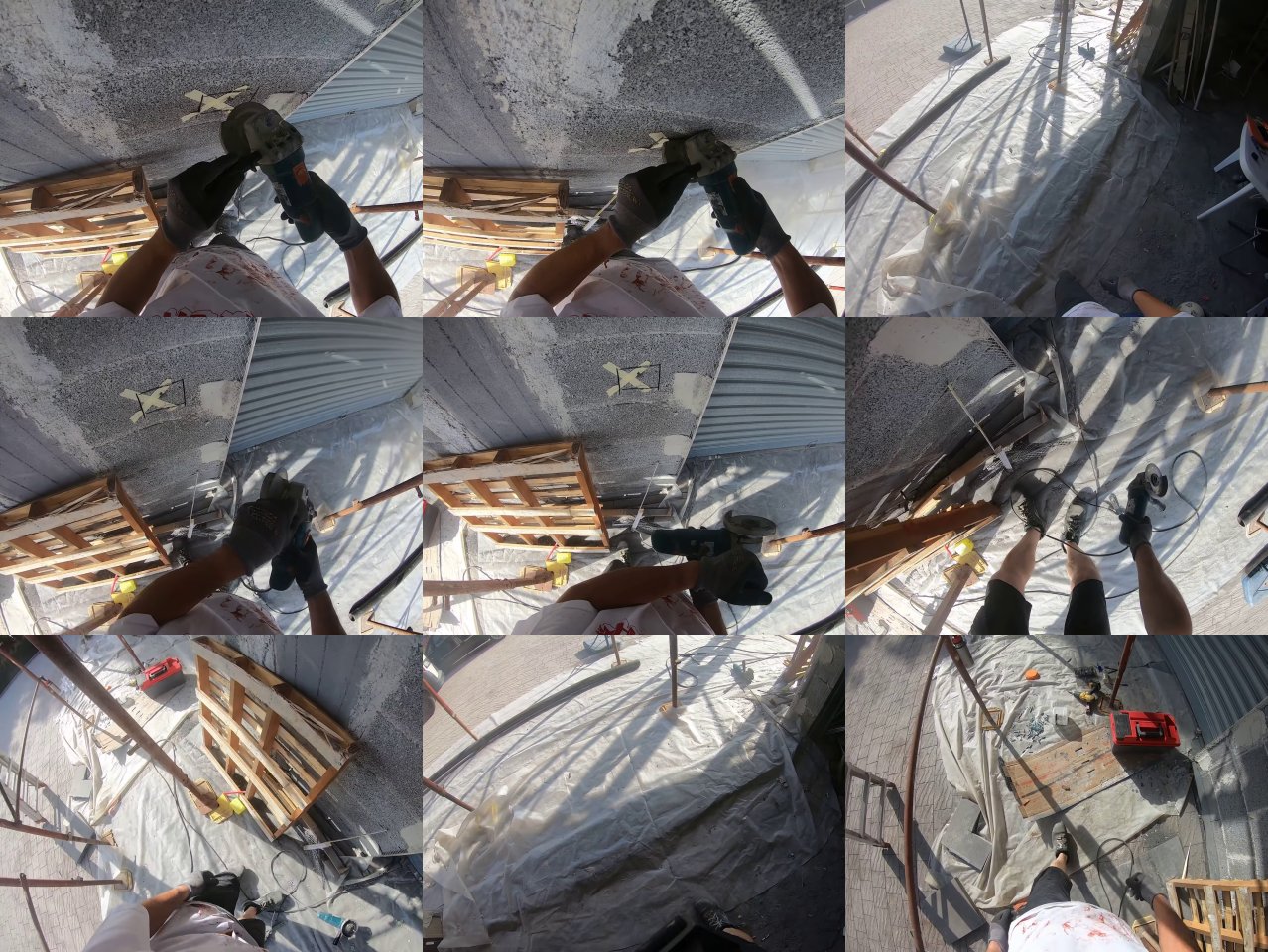
Reasoning-guided selection
Q: Where are the red pencil and folding ruler when the person picks up the angle grinder?
Options
A. Scaffolding plank
B. Plastic dust sheet ✓
C. Electrical backbox
D. Behind metal track
Model reasoning
“…visible on the white plastic dust sheet on the ground, near the base of the wall…”
→ Answer: (B) ✓
The reasoning trace confirms the model is interpreting the retrieved storyboard evidence, not guessing from text alone.
Results · Ego4D pilot
Click a column to sort. Teal-marked rows are the efficiency and accuracy operating points.
| {{ h.label }} {{ h.arrow }} | ||||
|---|---|---|---|---|
| {{ r.rep }} | {{ r.config }} | {{ r.accD }} | {{ r.tokD }} | {{ r.note }} |
Daily egocentric QA is visual-first. Storyboards increase temporal coverage per prompt token; retrieval granularity gives a tunable accuracy–cost knob. Evaluated on an Ego4D pilot — not on Project Aria data; OCR and lightweight metadata are natural future additions.
Module 04 · Situated Context Serving
System Vision · ContextStation Position Paper
Pair user-controlled memory with place-bound context
Personal agents need more than memory; situated questions also depend on current, place-bound facts. ContextStation reframes the local edge as a context-bearing serving tier, separating a regional Context Plane from an Inference Plane that decides whether a request is answered on a personal device, at a nearby station, or through controlled cloud fallback.
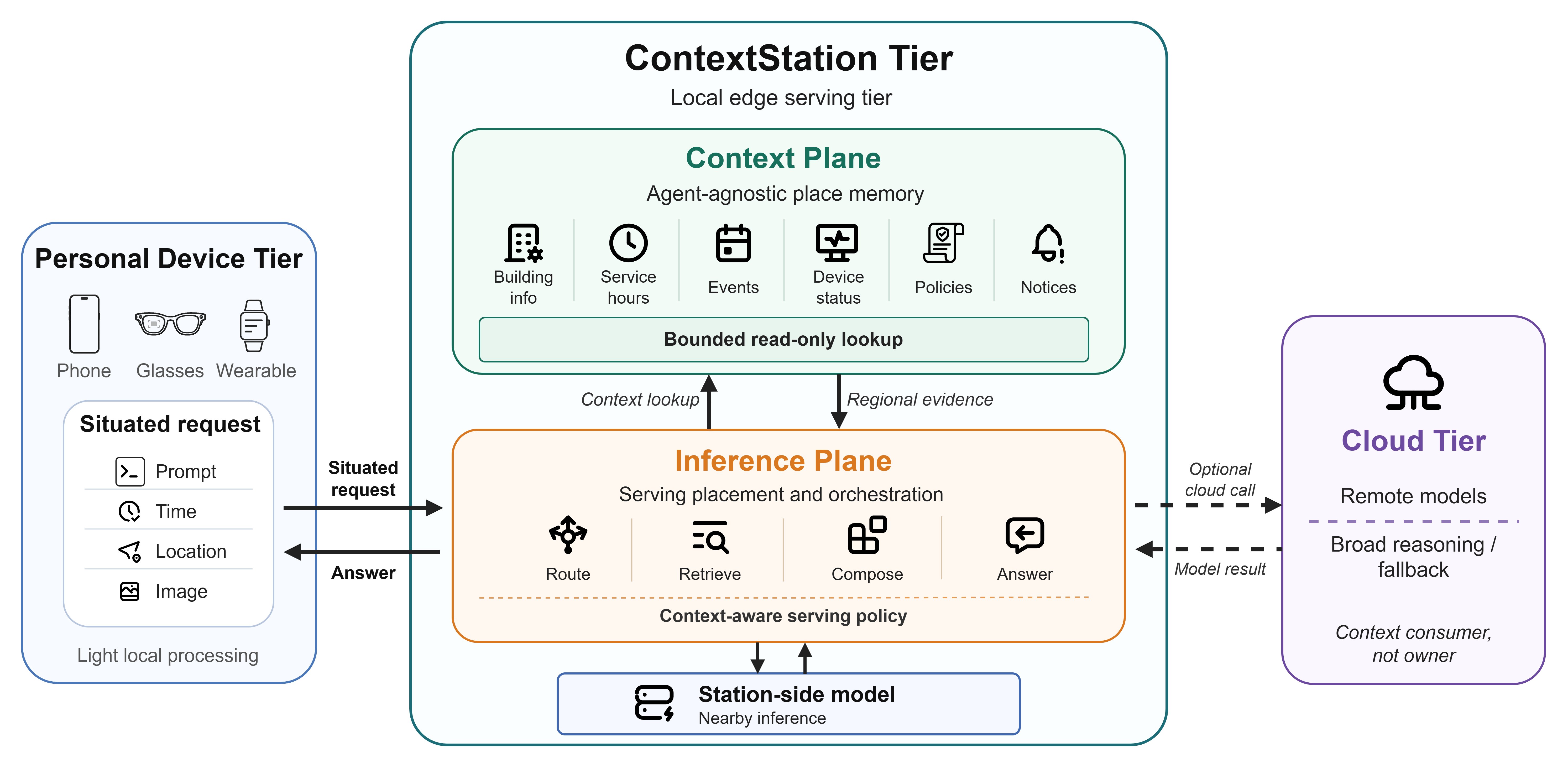
Personal memory is user-specific. Regional context is place-bound and shared. Personal evidence stays user-controlled; nearby context — building hours, notices, events, device state — is served through bounded interfaces.
Scenario 01
“Is the office I’m looking at open now?”
Needs image grounding, location, current building hours, and temporary notices.
Scenario 02
“What did I read earlier about this device?”
Combines user-controlled reading evidence with nearby device or lab context.
Scenario 03
“Summarize today’s relevant events.”
Future AR journaling may combine selected personal evidence with place-bound context and user intent.
- Context ownership ≠ model capacity.
- Regional context can be reused across nearby authorized users.
- Bounded read-only lookups keep models from owning the context store.
- Cloud models can be consumers of context, not default owners.
Putting the Pieces Together
An evidence lifecycle, not a finished product
These components are not yet one completed AR Journal. They are building blocks toward a system in which egocentric sensing becomes structured evidence, evidence remains under user-aware control, retrieval respects token and privacy constraints, and personal agents answer with grounded context rather than raw footage.
01
Raw egocentric video is not yet useful personal memory.
02
Evidence construction requires event detection, selection, grounding, and provenance.
03
Long-term retrieval must balance accuracy, token cost, privacy, and compute.
04
Nearby context serving helps agents answer situated questions without making the cloud the default owner.
Open questions
- ?How do we robustly select the right moments from continuous egocentric streams?
- ?When should we use modular CV pipelines versus unified multimodal VLMs?
- ?What evidence should remain on a personal edge device, and what can be safely offloaded?
- ?How should personal memory and regional context be combined without confusing ownership?
Contact and Materials
Papers, source materials, and extended figures
This page accompanies the Project Aria Research Summit poster “Toward Personal Egocentric AR Journaling.” Links below collect the related publications and project materials.